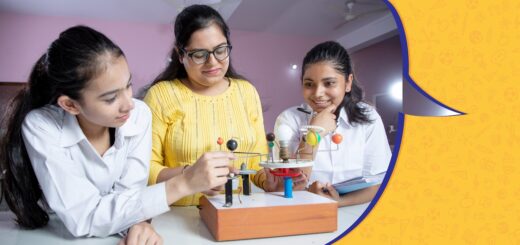
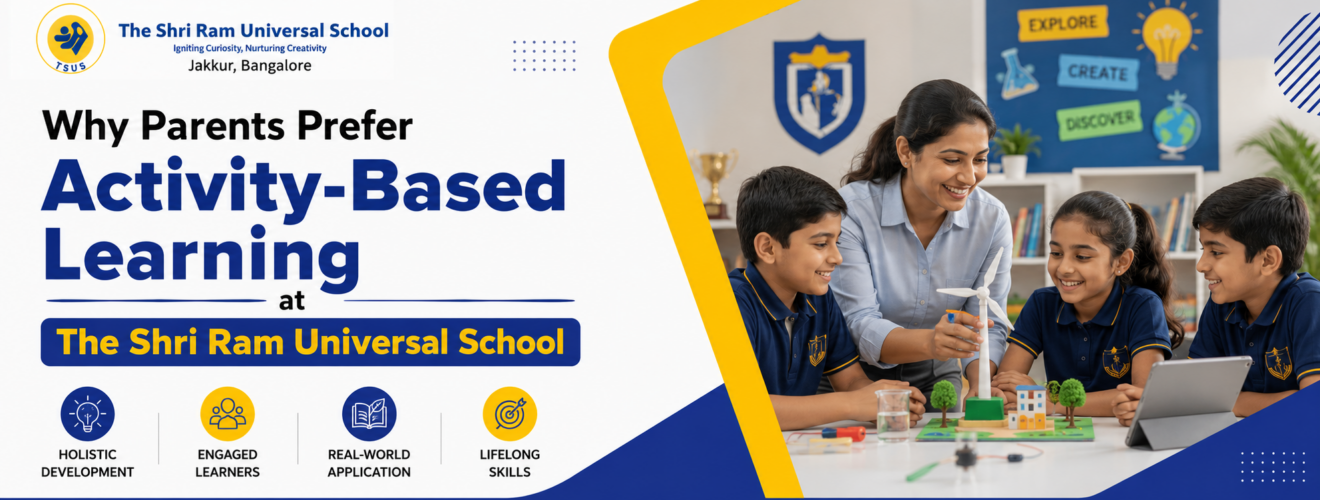
Why Parents Prefer Activity-Based Learning at The Shri Ram Universal School
Introduction
According to TSUS, the student-teacher ratio never goes above 1:10. OECD also says active learning is a powerful strategy for adaptive problem-solving. That combination matters for parents who want focused learning and strong support.
Many parents worry about rote learning. They want children to understand concepts properly. They also want learning that feels meaningful and calm.
This is where activity-based learning stands out. It helps children learn through experience, discussion, and action. This article shows why that approach works so well at TSUS Noida.
What is Experiential Learning and Why It Matters
Experiential learning means children learn by doing. TSUS explicitly describes its approach as experiential education beyond memorisation and rote repetition. The school says this builds deep understanding, critical thinking, and a love for learning.
This matters because children do not all learn the same way. Some understand faster when they see. Others learn better when they touch, speak, or build.
TSUS supports this through active participation. That means students do not only listen. They explore, ask questions, and connect lessons with real life.
How Are Engaging Learning Experiences Created Through Active Participation?
Active participation turns lessons into learning experiences. TSUS uses hands-on activities, collaborative projects, presentations, and discussion-led learning. Its FAQs also mention activity-based teaching, experimental learning, and experiential learning.
This approach helps children stay involved. They remember more because they take part. They also gain confidence while speaking and working with others.
A simple example is Circle Time. Another is Wonder Time. Both give children space to think, share, and respond.
Here is how active participation supports learning:
- it improves attention
- it strengthens memory
- it encourages communication
- it builds confidence
- it supports class engagement
Parents often prefer this because it feels practical. It also makes the learning process more enjoyable. Children stay curious when they help shape the lesson.
Why Does a State-of-the-Art Learning Environment Support Overall Development?
A strong learning environment changes how children behave. TSUS describes its campus in Greater Noida West as serene, nurturing, and world-class. Its brochure also highlights role play rooms, atrium spaces, indoor sports rooms, and display rooms.
That kind of setting supports overall development. Children need space to move, explore, and collaborate. They also need safety and comfort.
TSUS emphasizes child-centred learning and individual attention. That matters because children develop at different speeds. A well-planned environment helps each one grow steadily.
| Environment feature | Why parents value it | Effect on learning |
| Role play room | Encourages imagination | Builds social learning |
| Atrium | Opens group interaction | Supports collaboration |
| Indoor sports room | Keeps learning active | Strengthens coordination |
| Display rooms | Show student work | Builds pride and ownership |
Which Innovative Teaching Methods and Teaching Methodologies Make a Difference?
TSUS uses a wide range of teaching methodologies. Its FAQs say lessons are designed for visual, kinesthetic, and spatial learners. They also mention presentations, projects, self-study, peer teaching, and experiential learning.
The school’s differentiators include Circle Time, DEAR, DEED, Writer’s Workshop, and Research and Referral. These methods show that teaching is not limited to textbooks.
This helps in two ways. First, children understand concepts more clearly. Second, they develop habits that support future learning.
Parents often look for quality education that feels modern. These teaching methods do exactly that. They also make classrooms more responsive to different children.
How Do Project-Based Learning and Real-Life Application of Concepts Work?
Project based learning gives children a chance to apply ideas. TSUS says students learn through hands-on activities, collaborative projects, and real-world applications. The school also uses subject and theme-based trips to bring lessons to life.
This matters because abstract ideas can feel difficult. A project makes the idea visible. A real example makes it easier to remember.
For instance, a science concept feels clearer when linked to observation. A language concept feels stronger when used in a presentation. A maths idea feels more useful when applied in a problem.
That is why learning methods matter so much. They connect schoolwork to real life. They also help students understand why the lesson matters.
Why Do Role Playing, Field Trips, and Interactive Learning Methods Matter?
Role playing is one of the most useful interactive tools. TSUS includes role play through Choice Time and learning corners. Its approach encourages children to step into different characters and explore social interaction.
Field trips also play a strong role. TSUS prioritises experiential learning through school trips. These trips bring classroom lessons into the real world and support curiosity.
This mix is powerful because children remember what they experience. They also learn social skills naturally. That makes lessons feel more alive and less forced.
Interactive learning methods are especially useful in early years and primary classes. They encourage students to speak, listen, and cooperate. They also make learning feel safe and enjoyable.
How Does Activity-Based Learning Encourage Creative Thinking and Problem Solving?
Activity-based learning encourages students to think, not just repeat. TSUS says its method fosters curiosity, creativity, and ownership over learning. The school also highlights critical thinking, problem-solving, collaboration, and communication.
OECD also notes that teaching practices that encourage students to explore, generate, and reflect can unlock creativity and support empathy. That aligns well with activity-based methods.
A child who builds, discusses, or presents learns to solve problems. That is more valuable than memorising a fixed answer. It prepares students for both school and life.
Parents like this because it feels future-ready. It also supports emotional confidence. Children become more willing to try, fail, and improve.
How Does Activity-Based Learning Improve the Learning Process?
The learning process becomes smoother when children stay engaged. TSUS says its methodology is meant to support the mental, physical, and emotional well-being of children. That makes learning feel more balanced.
Activity-based learning improves understanding in several ways:
- it reduces passive listening
- it improves retention
- it encourages questions
- it supports peer learning
- it builds confidence in class
The result is a more natural learning rhythm. Children move from watching to doing. That shift is often what makes learning stick.
What Are the Benefits of Activity-Based Learning for Student Development?
The benefits of activity based learning are clear. Children become more confident, more curious, and more involved. They also develop essential skills in a steady way.
| Benefit | What it develops | Why it matters |
| Confidence | Speaking and participation | Helps classroom expression |
| Creativity | Original thinking | Supports flexible responses |
| Collaboration | Teamwork | Improves social learning |
| Problem solving | Independent thinking | Helps with challenges |
| Curiosity | Active questioning | Deepens understanding |
TSUS also integrates co-scholastic activities throughout the year. Those activities support learning beyond the classroom. That gives students a richer school experience overall.
How Does Quality Education Help Students Excel at TSUS?
Quality education is not only about marks. It is about consistent growth, good habits, and stronger learning outcomes. TSUS says it values personalised attention and a child-centred approach.
The school also uses reading, speaking, reflection, and exploration to build strong habits. That helps children feel ready for later classes. It also supports long-term academic confidence.
For parents in Noida, that balance matters. They want a school that feels structured, but not rigid. They also want a place that encourages students without pressure.
How Does The Shri Ram Universal School Encourage Students to Excel?
TSUS encourages students to excel by combining structure with freedom. Its philosophy supports independence, critical thinking, and a lifelong love for learning. The school’s official pages show a strong focus on experiential and active learning.
Students are encouraged to explore, experiment, and enjoy learning. That kind of environment builds confidence over time. It also helps children become more self-reliant and thoughtful.
For many parents, that is the real advantage. They are not just choosing a school. They are choosing a learning environment that supports the whole child.
Final Thoughts
Activity-based learning gives children a better way to grow. It builds understanding, creativity, problem solving, and confidence. It also makes school feel connected to real life.
At The Shri Ram Universal School, that approach is visible in the classroom and beyond. From project based learning to field trips, the model is designed to support overall development. For families in Greater Noida West, TSUS is one school worth reviewing. Talk to Expert.